
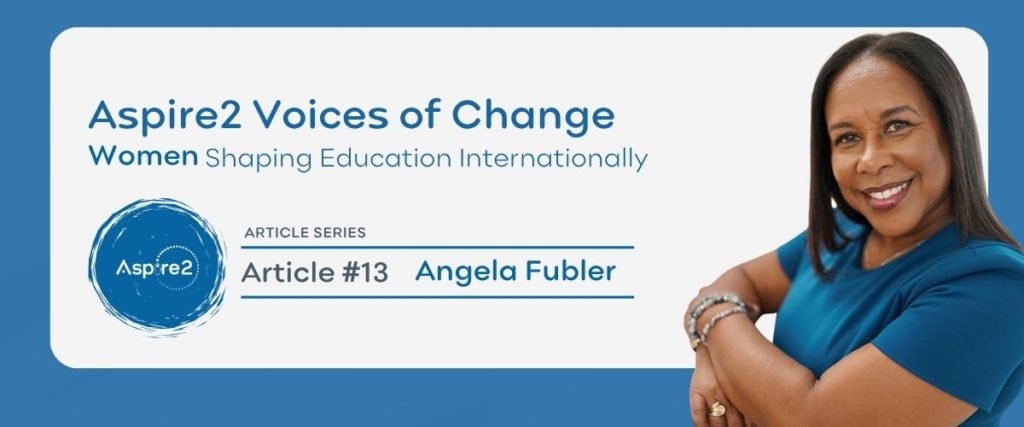
Article #13 – Angela Fubler
Angela Fubler is an experienced international education leader with more than three decades in the sector. She is the Founder of Chatmore British International School and a Member of the Board of Directors at COBIS, contributing to the Membership and Professional Learning Committees. Angela is passionate about strengthening international education and supporting the professional growth of educators worldwide, while also working as a Strategic Advisor with Eaglemann Learning & Innovation Group to support small schools in building sustainable learning communities.
What inspired you, as a woman, to take the step into educational leadership?
Growing up, many of the most professional people I knew were teachers. Almost all of my academic learning experience was shaped by women who were knowledgeable, patient, kind, and held high standards. They were, in many ways, everything I aspired to be.
That influence was reinforced at home. My mother and grandmothers were entrepreneurs and leaders in the community, though no one ever paused to define their leadership “as women.” It was simply how they lived, with service, strength, wisdom, and responsibility woven into everyday life.
When I reflect on my own path, I realise I was not inspired by a single moment. From a very young age, I simply saw myself as a teacher. I even practiced teaching with my two younger sisters. What shaped me most was a consistent thread of family, community, and teachers who recognised the potential in me before I fully saw it myself.
That experience shaped my educational philosophy. I believe family, community, and a culture of learning drive educational success. When children experience school, home, and community as connected spaces of value and expectation, learning has a much stronger foundation.
What achievements in your leadership journey make you most proud?
What makes me most proud is the establishment of Chatmore British International School.
I did not build it alone. I had the support of my family and of teams who trusted me along the way. But I know that journey intimately, and I know what it required of me. I had to overcome a great deal, and I had to keep believing in the vision for the school even during seasons when I was deeply tired and, at times, ready to let it go.
I remember one moment especially clearly. My husband and I went to a professional to help us work out how to sell the school. Instead of guiding us toward that outcome, he said, “Against my better judgement, I can’t see why you would want to rid yourself of something that is on its way to becoming very successful.” I left feeling frustrated at the time, but I now see that moment as part of the story of perseverance.
So, while I am proud of the school itself, I am equally proud of the resilience, pioneering spirit, and perseverance it took to build it. I am proud that it has become a quality educational environment, a place of many firsts, and, unexpectedly, a place where my daughter now leads and my grandchildren love to learn.
That, to me, is deeply meaningful. It is a legacy, but it is also living proof that what we build with conviction can continue to serve beyond us.
What challenges have you faced as a woman in leadership and how have you navigated them?
This is both an easy and a difficult question to answer.
It is easy because one of my greatest challenges has been the experience of having my expertise devalued by colleagues and professionals I respected, many of them women. That reality shifted my understanding of professionalism and, for a time, affected my trust.
It is difficult because I do not live in that pain every day. I have moved beyond much of it, though there are still moments when past experiences resurface. Those closest to me understand that some of this stemmed from an unfortunate misuse of kindness.
What these experiences taught me was the value of asking thoughtful questions. I learned that things are rarely as simple as they appear, and that careful questioning is not a weakness but a discipline. I also learned to question myself first: Is this question necessary now, or is it my fear speaking? If I wait, what might I learn?
While I am no longer the same trusting person I once was, I am more discerning and deeply grateful for the people in my professional life who offer support, strength, and honesty.
My journey as an entrepreneur and businesswoman has strengthened me. It has made me more resilient and more committed to making a positive difference in my community and in the lives of my children and grandchildren. These experiences have also shaped my leadership. I value understanding people, practicing forgiveness, and maintaining perspective, allowing me to lead with professionalism without becoming hardened.
How do you feel women leaders are influencing the future of education today?
Women leaders are influencing the future of education in ways that are both visible and deeply structural. They are not only leading institutions; they are also reshaping how we understand leadership itself.
I believe women often bring a particular strength to education: the ability to hold high standards and deep humanity at the same time. They understand that schools are not simply systems of delivery; they are living communities made up of children, families, educators, and all the complexity that comes with being human.
This perspective connects closely to my own belief that family, community, and a culture of learning are central to educational success. When these elements are aligned, students thrive. When they are not, children can struggle to see learning as meaningful or supported.
Professional experience has taught me that change is possible when people are willing. Families can shift, values can deepen, and trajectories can change. But it has also taught me to be realistic. Some students will always need more support, and we cannot always change every outcome. What we can do is become a meaningful chapter in their story, leaving them with something they may return to later in life.
This is why the influence of women leaders matters. Many are helping move education away from systems that prioritise performance over people and toward approaches grounded in dignity, relationships, and human need. As Dr. Mette Miriam Boell describes in Compassionate Systems Thinking, leadership requires a commitment to care, clarity, and kindness in how systems are designed and experienced.
Women leaders are helping educators become more compassionate, more responsive, and more attuned to the realities of students’ lives. That influence is not soft; it’s essential.
What message or advice would you share with the next generation of women aspiring to lead in education?
Make time for your thoughts and address whatever may be preventing you from being the most authentic version of yourself. As women, we can sometimes feel pressure to prove we are capable or accomplished. Ambition and achievement have their place, but they should never come at the expense of who you truly are.
Leadership is strongest when it is grounded in authenticity. If success requires you to become unrecognisable to yourself, then something important has been lost.
I would also say this: if something disturbs your sleep for more than a week, pay attention to it. It may be calling you toward action, courage, or clarity. Often, our deepest instincts surface before we can fully explain them.
Years ago, a respected mentor gave me Karen Salmansohn’s book Gut after observing my leadership style. It affirmed something I had already learned, which is to trust that intuition as a valuable guide. As Salmansohn writes, “For a variety of reasons, some psychological, some anthropological, the gut is a valuable asset.”
Trust your intuition. Honour your thinking, but do not ignore your instincts. Women in education are shaping the future every day, and they should do so by bringing their most grounded and authentic selves into both the classroom and the boardroom.
And wherever possible, choose joy, not performance, imitation, or exhaustion disguised as success. Choose the kind of life and leadership that allows you to remain whole.
What is something you are passionate about?
I am passionate about restoring teaching and education to the level of respect and professionalism they held when I was a young student. Through my work as Programme Innovation Lead at the Chatmore Foundation, I hope to encourage both local and global communities to value kindness not as a secondary trait, but as a meaningful professional standard. This does not diminish the importance of academic achievement. I value scholarly contributions deeply and hope to continue my own doctoral journey in the future. However, I do not believe titles alone should define our worth. Some of the most influential educators in my life never relied on titles; their presence, standards, and humanity spoke for them.
I am also deeply interested in understanding children, their differences and similarities, their place within families, and the people in their lives who most value education. One question that fascinates me is: who does a child believe values education most in their family or community? With parental support, that person can often become a powerful source of motivation, because learning becomes more meaningful when it is connected to love, identity, and belonging.
I care strongly about multigenerational education and the belief that “retired” does not mean “expired.” I want to see young people develop the confidence and courage to lead with purpose and possibility. I also believe in the transformative power of international education and travel experiences, particularly those connected to the Sustainable Development Goals and relevant to this region of the world.
Alongside this, I remain committed to growing the Bermuda-based No School Is an Island Conference into an international gathering that connects continents and highlights Bermuda as a place of learning, wellbeing, and influence.
At the heart of all of this is one enduring belief: education works best when it is connected; connected to family, community, culture, purpose, and the full humanity of every learner.