Aspire2 Article Series: Voices of Change, Women Shaping International Education
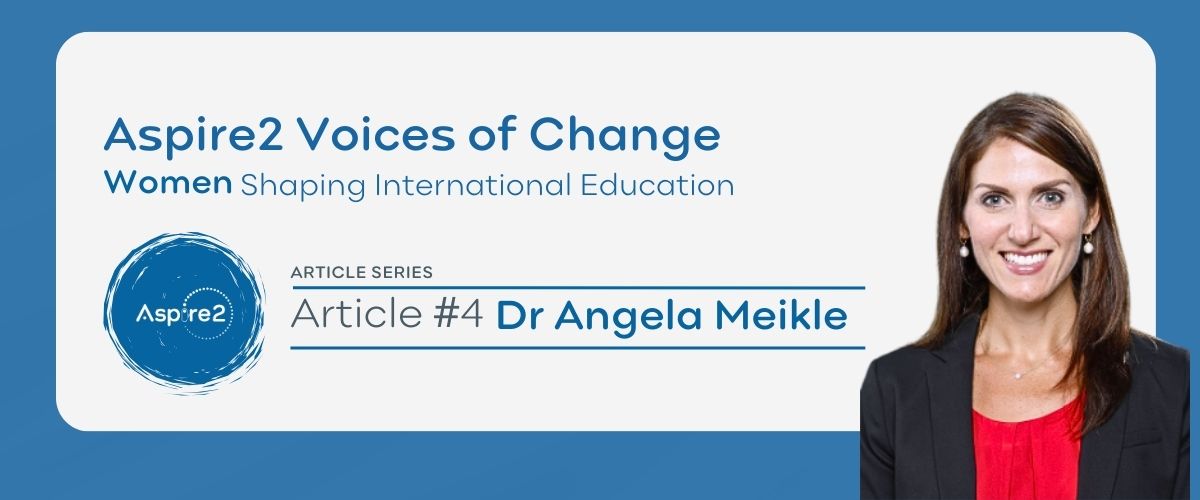
Article #4 – Dr. Angela Meikle
Originally from California, Dr Angela Meikle is an experienced educational leader with two decades of international education experience across IB schools in China, Vietnam, and Singapore. Her roles as a teacher, learning leader, curriculum coordinator, and Head of Elementary have shaped a strong foundation for her work with the International Baccalaureate, where she supports schools optimise their implementation of an IB education.
Based at the IB Global Centre in Singapore, Angela now serves as the Global Head of Private IB World Schools, leading a team that supports more than 3,300 authorised schools across 161 countries. She holds a BA in Child and Adolescent Development, an MA in Educational Leadership, and an EdD focused on the impact of action research in IB schools. Guided by a service-leadership approach and underpinned by systems thinking and appreciative inquiry, Angela is committed to fostering innovation, continuous improvement, and future-focused education that supports both human and planetary flourishing.
What inspired you, as a woman, to take the step into educational leadership?
Stepping into educational leadership was influenced and shaped by the remarkable women I had the privilege to work with throughout my career. Early on, I was surrounded by female leaders who combined intelligence, courage, connection, good humor, authenticity and compassion in ways that made leadership feel both aspirational and attainable. They modeled what it meant to lead while also creating space for others to grow and shine. Their influence gave me the confidence to pursue roles where I could make a broader impact, and through mentorship showed me the transformative power of women lifting one another up.
What achievements in your leadership journey make you most proud?
Recently, an achievement that stands out is completing my doctorate while working full time and raising a family. That journey was both demanding and deeply meaningful. It required early mornings, weekends, balancing strategic priorities, and a constant reminder of why the research mattered. My doctoral study explored how leaders and school communities can leverage and integrate action research to build a school’s organizational capacity and influence collective efficacy and identity.
Balancing professional responsibilities, academic research, and family life is not a neat or linear process. There were moments of doubt and sacrifice, and there was also growth that developed from persistence and purpose. I learned you don’t need perfect conditions to pursue big goals, rather focus on the next small action or baby step forward that brings you closer to the outcome.
What challenges have you faced as a woman leader, and how have you navigated them?
Like many women, I’ve had to learn that leadership is not about always being liked, it’s about being trusted. Often, it involves communicating information that others are not thrilled to hear. Early on, that felt uncomfortable, and I worried more about perception than purpose. Over time, I realized that clarity is an act of care. As Brene Brown reminds us, “clear is kind”.
Another challenge is the “double-bind” researchers Chitkwe et al. (2024) describe for women in leadership who navigate many polarities and frequently juggle the expectation to be collaborative and decisive, supportive and assertive, confident and likeable… the challenge is holding these tensions with awareness when they arise. I’ve learned it is possible to hold others accountable and still lead with humanity, empathy, and heart.
My current role requires a healthy amount of travel and time away from home. As a female leader, this is a challenge as a mom and wife, however I am blessed to have an incredibly supportive husband and family who support my international responsibilities and events. Their support makes my leadership possible.
How do you feel women leaders are influencing the future of international schools today?
Schools globally are recognizing the importance of communities grounded in belonging, well-being, and strong relationships. The future of international schools is, and will be, deeply rooted in connection. Women leaders are reshaping international schools by elevating the principles that hold learning communities together: collaboration, wellbeing, cultural responsiveness, social responsibility, and sustainability.
What message or advice would you share with the next generation of women aspiring to lead in education?
Build and grow your support network. We deeply benefit from holding an abundance, over scarcity mindset, when it comes to opportunities for female leadership. Also, don’t wait to be fully ready before stepping forward. Readiness is often the byproduct of action, not its prerequisite.