
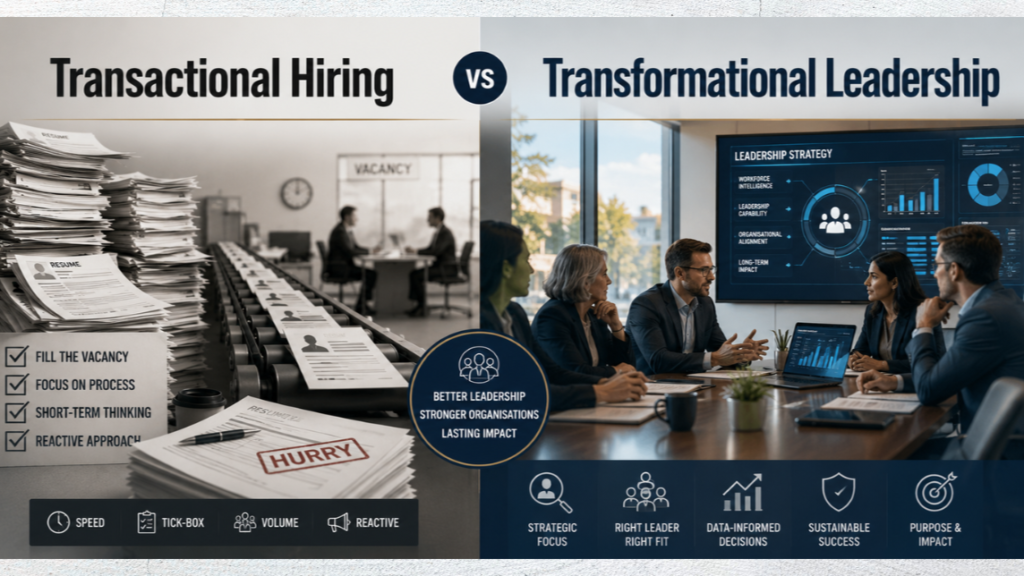
Too many organisations still approach recruitment like a transaction.
A role becomes vacant. An ad goes live. Applications come in. Interviews happen. A placement is made.
Then everyone hopes for the best.
But leadership recruitment, particularly in education, has never really been that simple.
The problem with transactional recruitment is that it often focuses on filling a position, rather than truly understanding what success in that role requires.
It can prioritise speed over strategy, process over purpose, and short-term placement over long-term impact.
And that can come at a significant cost.
Because when organisations fail to properly assess leadership fit, cultural context, stakeholder expectations, or future workforce needs, even highly capable appointments can struggle.
Not because the leader lacked talent.
But because the process lacked depth.
This is where a more strategic, data-informed approach matters.
Better recruitment is not just about sourcing candidates.
It is about asking smarter questions:
Why does this role exist now? What challenges will this leader actually inherit? What capabilities are essential beyond the resume? What organisational conditions will influence success or failure?
When recruitment becomes more advisory-led, evidence-based, and context-driven, it moves beyond simply filling vacancies.
It becomes a tool for stronger leadership, healthier organisations, and more sustainable outcomes.
Because the real goal should never just be placement.
It should be placing the right leader, in the right environment, for the right reasons.
That is where recruitment shifts from transactional to transformational.