
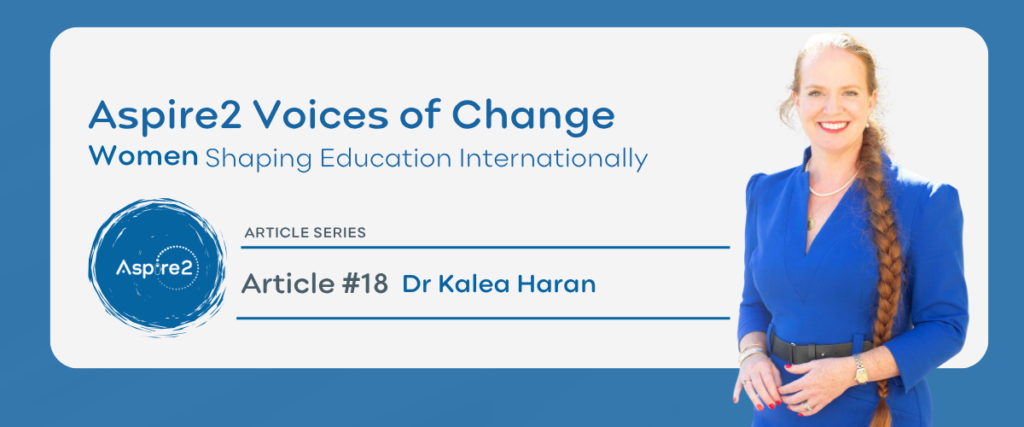
Dr Kalea Haran is the Principal of Penrhos College, a day and boarding school for girls in Perth, Western Australia. She brings a career spanning Business, Law and Education across the United Kingdom, Singapore and Australia, having held senior leadership roles including eleven years with the Harris Federation in London and eight years at the Australian International School, Singapore, where she served as Head of Secondary and engaged closely with the Council of International Schools and the International Baccalaureate.
Kalea holds an MBA, a Master’s in Education, and a Bachelor of Education in Administration Management and Law, and has completed a PhD at Curtin University examining the careers of Australian women leaders in STEM. She was awarded Chartered London Teacher Status in 2009 and holds Fellowship of The College of Teachers. Guided by her leadership philosophy, Courage Starts Here, Kalea is committed to preparing girls not only for academic success, but to lead with confidence in a future without boundaries.
What inspired you, as a woman, to take the step into leadership?
I’m not sure there was ever one defining moment when I decided, “I want to be a leader.” My career has been much more of a journey than a carefully mapped path.
What has always motivated me is the opportunity to make a difference beyond my own classroom or immediate area of responsibility. I loved teaching, but as I moved into different roles, I realised leadership gave me the opportunity to influence the conditions in which other people could thrive – students, staff and ultimately an entire community.
As a woman, I have also become increasingly conscious of the importance of visibility. Girls need to see women making decisions, leading organisations, taking risks, using their voices and occupying positions of influence. As Principal of a girls’ school, I feel an enormous responsibility, and privilege, in that. We cannot tell girls that their futures are without boundaries if we are not prepared to challenge some of those boundaries ourselves.
My PhD research into Women leaders in STEM reinforced this for me. The women I interviewed rarely described perfectly linear careers. Their journeys involved opportunities, setbacks, mentors, sponsors, family decisions, courage and sometimes unexpected changes of direction. In many ways, that reflects my own experience of leadership too.
What achievements in your leadership journey make you most proud?
The things I am proudest of are probably not individual achievements, but the things I have been able to help create with others.
Leading Penrhos College is an enormous privilege. I am particularly proud of the clarity we have developed around who we are and what we want for our girls, our purpose to revolutionise girls’ education and our vision for a world where girls live a future without boundaries. For me, those cannot simply be words on a strategic plan. They have to influence the experiences we create for girls every day.
I am proud when I see young women finding their voice, taking intellectual risks, stepping into leadership or imagining a future for themselves that they might not previously have considered possible.
I am equally proud of creating opportunities for others to lead. Leadership should never be about building dependency on one person. Some of the most satisfying moments in my career have been watching people I have encouraged or supported step forward and discover capabilities in themselves they perhaps did not initially see.
Completing my PhD while serving as a Principal is also something I am very proud of. It took persistence, curiosity and a fair amount of resilience. More importantly, it has allowed me to bring together two things I care deeply about: education and understanding how we create environments in which women can build successful, sustainable careers.
What challenges have you faced as a woman leader, and how have you navigated them?
Like many women, I have encountered assumptions about what leadership should look and sound like.
There can still be a narrow line women are expected to walk: confident, but not too confident; decisive, but still warm; ambitious, but not perceived as overly ambitious. Women can find themselves carrying expectations around likability and emotional labour that are not always applied equally to their male counterparts.
My research showed me that these experiences are not simply individual. Across three generations of Australian women leaders, I heard stories of gender bias, stereotypes, underrepresentation, opaque pathways to advancement, work-family pressures and, for some, bullying or harassment.
But I was equally interested in what enabled women to keep progressing. Mentors mattered. Sponsors mattered. Male allies mattered. Networks and family support mattered. And so did the capabilities women developed themselves – resilience, self-efficacy, strategic thinking, versatility and a strong sense of leadership identity.
One of the lessons I have learned personally is not to spend too much energy trying to fit someone else’s model of what a leader should be. I try to lead consistently with my values, seek wise counsel, surround myself with people who will challenge my thinking, and be prepared to make difficult decisions when they are required.
Courage in leadership is not the absence of doubt. Often, it is being willing to move forward thoughtfully despite it.
How do you feel women leaders are influencing the future of education today?
Women are already shaping education enormously, but I think the next challenge is ensuring women are equally represented in the places where the biggest decisions about its future are being made.
Education is being reshaped by AI, changing workforce expectations, student wellbeing, new understandings of learning science and rapidly changing social and technological environments. We need diverse voices around the tables where responses to those challenges are designed.
Women bring many different leadership styles and perspectives, there is no single way that “women lead.” That diversity itself is important.
In girls’ education, I think we have an additional opportunity. We are not simply preparing girls to participate in the world as it currently exists; we should be preparing them to shape the world they will inherit.
That means developing much more than academic knowledge. We need young women who can think critically, communicate, collaborate, create, exercise compassion and cultural competence, and importantly, have the courage to act.
If we want more women leading universities, schools, businesses, laboratories, governments and communities in twenty years’ time, the foundations for that confidence and leadership identity are being built in our schools today.
What message or advice would you share with the next generation of women aspiring to lead in the education sector?
Don’t wait until you feel completely ready.
One of the strongest messages from my research, and from my own career, is that careers are rarely linear. Sometimes the opportunity that appears to take you sideways actually gives you the experience you need for the next step.
Be curious. Keep learning. Say yes to opportunities that stretch you. Find mentors, but also find sponsors – people who will advocate for you when you are not in the room. Build genuine networks and invest in them. Seek out people who think differently from you.
And don’t believe you have to become somebody else in order to lead.
There will be moments when leadership is uncomfortable. You will make mistakes. You will receive criticism. There will be decisions where no option makes everyone happy. Learn from those experiences without allowing them to diminish your willingness to lead.
Most importantly, remember that leadership is not about the title. It is about impact. Ask yourself: What becomes possible for other people because I chose to lead?
That is a much more powerful measure of leadership than the position written beneath your name.
Tell us about a project, initiative or topic you are passionate about.
One of the areas I am most passionate about is the intersection between girls’ education and women’s leadership.
My doctoral research explored the careers of 30 Australian women leaders in STEM across three generations. What struck me was that while the context had changed across generations, many of the underlying challenges experienced by women had not disappeared.
At the same time, the research demonstrated the extraordinary agency of women. Their successful careers were rarely straight ladders. They looked much more like lattices – moving sideways, upwards, occasionally backwards, pausing and re-entering as women accumulated experience, relationships and confidence.
That has important implications for how we educate girls.
If we want women to thrive in leadership later in life, we cannot wait until they enter the workforce to begin developing their leadership identity. Schools have an important role in helping girls develop confidence, courage, resilience, curiosity and the capacity to navigate complexity.
Every day, at Penrhos, our girls see women leading. They see girls occupying every student leadership position, participating across STEM, sport, the arts and public life, taking intellectual risks and learning to use their voices.
Ultimately, I want our girls to leave school not asking, “Am I allowed to do this?” but instead asking, “What could I make possible?” That is what a future without boundaries means to me.