
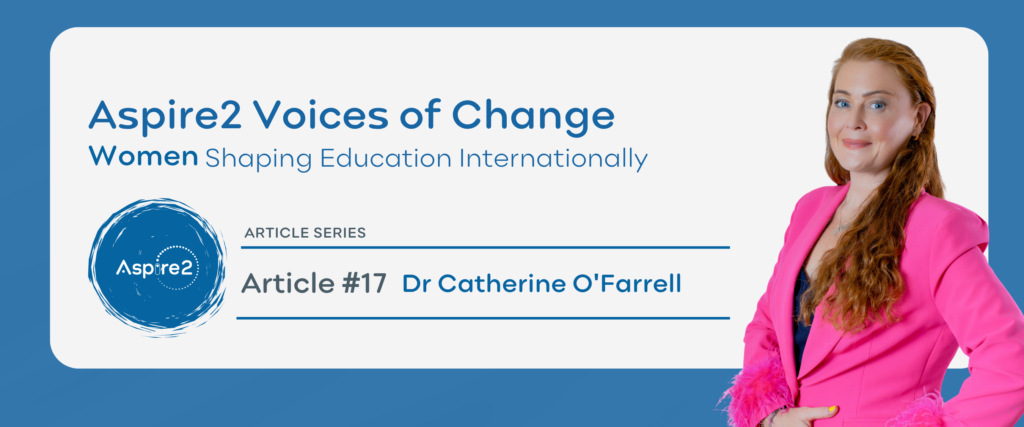
Dr Catherine O’Farrell is the Founding Partner of Incluzun, a Dubai-based consultancy supporting schools, education groups, corporate and government organisations across the MENA region to strengthen inclusive practice, wellbeing and organisational readiness. With a background as a corporate leader and psychotherapist, she combines systems thinking, psychology and educational leadership to help organisations identify targeted, strategic improvements rather than relying on generic solutions.
Catherine is an International Inspector with Tribal Group and serves in several governance roles, including Chair of the Board at GEMS Al Khaleej International School, and Governor at both St Mary’s Group of Schools and Delhi Private School, Sharjah. She was appointed Co-Chair of the UNESCO Committee for Inclusive Practitioners in the Gulf and founded the National Inclusive Practice Awards, recognising practitioners who are advancing inclusion for children with additional needs.
She holds a Doctorate in Educational Management and an MSc in Systems Engineering from The Open University. A respected international speaker and media contributor, Catherine is recognised for connecting inclusive practice with measurable organisational outcomes and sustainable improvement, aligned with the United Nations Sustainable Development Goal 8.
What inspired you, as a woman, to take the step into leadership?
Leadership wasn’t a destination I planned; it found me through adversity. Eight years ago, I was cycling my bike in Dubai when I was hit by a car. I broke my spine in five places, eight ribs, my hip and shoulder. It was the day before my first ever corporate role. I was captain of my rugby team and life was fast and furious, until it wasn’t. I came frighteningly close to never walking again. During that journey, I experienced, even briefly, the barriers that people with disabilities face every single day. It changed me forever and really directed me toward working for a more inclusive community.
I’ve always been fascinated by systems thinking and engineering, understanding how complex systems work and, more importantly, how they fail people. I realised education wasn’t broken because people didn’t care; it was because systems weren’t designed with everyone in mind.
That became the beginning of Incluzun.
As an Irish woman, I’ve always believed in backing yourself, even when the odds aren’t in your favour. Or as we’d say at home, “Sure, if not now, when?” Leadership, for me, is simply seeing a better way, bringing good people together, and having the courage to build it.
What achievements in your leadership journey make you most proud?
Awards are wonderful, but the moments that stay with me are far more personal, a child attending school for the first time because they finally have the right support, a parent telling us they have hope again, or a Learning Support Assistant discovering a career they love.
Today, Incluzun is a certified social enterprise supporting more than 1,000 children and families, working alongside government partners including Majra, the National CSR Fund, and the Zayed Authority. Every step we take is guided by the UN Sustainable Development Goals, particularly SDG 4 (Quality Education) and SDG 8 (Decent Work).
I’m equally proud of the community we’ve built. None of this happened alone. Harmeet and Raza have been incredible partners, and my family and friends have carried me through the difficult days.
Success isn’t measured by revenue or recognition. It’s measured by lives changed, and we’re only getting started.
What challenges have you faced as a woman leader, and how have you navigated them?
Like many women, I’ve occasionally walked into rooms where people underestimated me before I’d even spoken. Early on, I felt I had to prove myself repeatedly. Corporate education in the UAE is a dog-eat-dog landscape. Yes, we are focused on students, but there is huge competition, insane politics, and you never feel fully secure in your job. It teaches you a lot, in so many different ways. Over time, I realised the best response wasn’t to become louder, it was to become better.
The greatest challenge, however, wasn’t being a woman. It was rebuilding my life after my accident. Recovery taught me resilience, patience and perspective. It also taught me that vulnerability isn’t weakness; it’s often where the strongest leadership begins.
I’ve also been incredibly fortunate to have extraordinary people beside me. Harmeet and Raza have challenged and supported me in equal measure, and the three of us have created an organisation that we can confidently say is having a positive impact, no matter how small!
How do you feel women leaders are influencing the future of education today?
Women have always shaped education; today they’re reshaping the systems behind it.
The women inspiring me aren’t simply leading schools, they’re redesigning how learning happens. They’re asking better questions about belonging, wellbeing, accessibility and innovation. They’re proving that academic excellence and compassion aren’t competing priorities.
My first truly inspirational leader was a powerful woman, a principal who didn’t focus just on education, but on how her team operated and functioned. She used terminology from management and corporate systems that we (the SLT) had never heard in education before, she was transformative. I’ve met many powerful female leaders since then, women who are striding forward in education to revolutionise how we operate. There are a number of networks in the UAE, but WomenEd UAE, led by Nalini Cook, is one where we see powerful women coming together to share and support each other.
My own passion lies in systems thinking. I believe inclusion shouldn’t rely on extraordinary teachers doing extraordinary things. It should be embedded into the design of every policy, every classroom and every decision. When we engineer systems for those who need the most support, everyone benefits.
That’s the future I want to be part of and one I believe is well within our reach.
What message or advice would you share with the next generation of women aspiring to lead in the education sector?
Don’t wait until you feel ready, you probably never will.
Be curious. Read widely. Listen carefully. Ask difficult questions. The best leaders aren’t those with all the answers; they’re the ones willing to keep learning. It’s better to ask 33 stupid questions than to ask none at all and get it wrong!
Most importantly, don’t let setbacks define your future. Some of the greatest opportunities in my life came disguised as the hardest moments. My accident could have been the end of my story; instead, it became the beginning.
Surround yourself with people who challenge you, encourage you and remind you why you started. Leadership is never a solo journey. And don’t fear the boss. Education is particularly guilty of creating fear in teachers and leaders (we’re like mini adult students). We are afraid to stand up, afraid to speak out, or afraid to walk away. No job is worth your health or wellbeing. Period!
Finally, always remember who you’re serving. Titles fade, but impact lasts. If one child has greater access to education because of your work, you’ve already changed the world.
Tell us about a project, initiative or topic you are passionate about.
My greatest dreams lie with Incluzun.
What began as an idea between Harmeet and me has grown into a certified social enterprise with a simple but ambitious mission: to support more and more children with additional needs to access education, employment and opportunity.
We’re proud to work alongside government partners, schools and families to build practical, sustainable solutions that align with UN Sustainable Development Goals 4 and 8. But we’re thinking beyond programmes. We’re redesigning systems.
My background has made me fascinated by engineering organisations that are resilient, inclusive and scalable. Real change happens when inclusion isn’t an initiative; it’s built into the architecture of how organisations operate.
The journey hasn’t always been easy, but adversity has been my greatest teacher. It taught me that impossible is often just something that hasn’t been designed differently yet. And that gives me enormous hope for the future.
I hope more and more educators see beyond the classroom to the impact they can have across the wider educational landscape. Be brave and take the leap!