
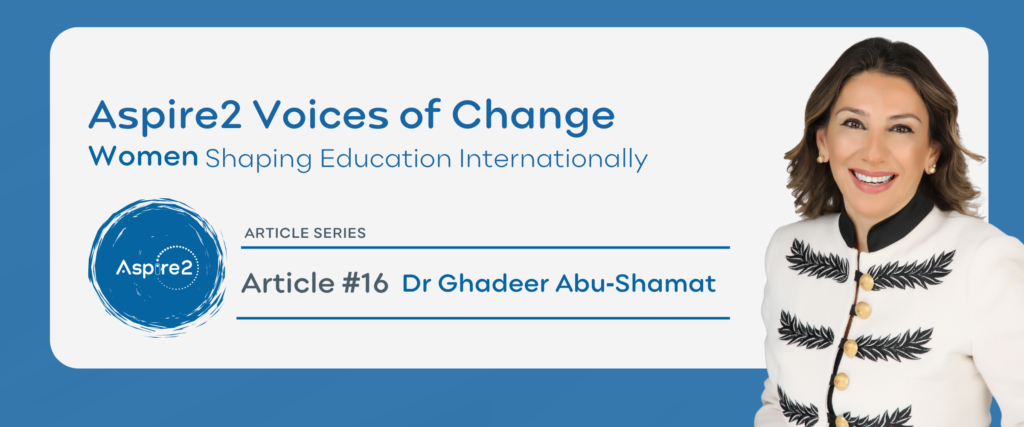
Dr Ghadeer Abu-Shamat is an experienced international education leader with extensive expertise across educational leadership, school improvement, teacher development and strategic educational management. She currently serves as Executive Vice President at GEMS Education and recently completed her Doctorate in Educational Leadership from the UCL Institute of Education, further strengthening her commitment to advancing educational excellence and leadership practice. Passionate about empowering educators, fostering innovation and supporting high-quality learning environments, Ghadeer is dedicated to creating meaningful impact across school communities while contributing to the ongoing development of education on a global scale.
What inspired you, as a woman, to take the step into educational leadership?
Women’s leadership in education in Jordan is both well-established and widely accepted. In fact, the sector is largely feminised, particularly in private education, where women make up the majority of school leaders and principals. In this context, while my leadership journey was not unusual in terms of gender, it was deeply personal and unexpected in the direction it ultimately took.
Interestingly I entered education almost by coincidence. I never planned to pursue a career in the field. My original aspiration was to become a doctor or a pharmacist, which led me to study chemistry, as it was the closest pathway to pharmacy at the time. Teaching was never part of the plan; it simply became the opportunity that presented itself.
I began my professional journey teaching elementary students before moving on to upper grades to teach physics and chemistry. Leadership was never part of my original plan, and I did not aspire to become a principal. However, at the age of 26, I was unexpectedly selected by the school owner to take on the role of principal, making me one of the youngest in Jordan at the time.
When I questioned why I had been chosen over colleagues who had far more experience. the answer was both humbling and deeply affirming. I was told that my students had put my name forward, highlighting my strong classroom management and the respectful, professional relationships I had built with them. The school owners also shared that they saw in me wisdom and maturity that went beyond my years.
Although I had spent six years teaching , it was only when I stepped into leadership that I truly discovered my true passion. For the first time, I could see the broader impact I could have, not only on students, but also on teachers and school culture and the wider learning environment. That realisation became the turning point that inspired my long-term commitment to educational leadership.
What achievements in your leadership journey make you most proud?
I am proud of the meaningful and lasting impact I have been able to create for both students and educators throughout my leadership journey. One of the achievements closest to my heart has been strengthening student voice and student leadership, ensuring that learners are not only heard but genuinely empowered to shape their educational experience.
Another defining milestone in my journey has been leading and sustaining the transformation of the school I currently serve, guiding it into a successful and thriving learning environment, with students’ achievement placed firmly at the centre of every decision. This transformation required clarity of vision, consistency, and a relentless focus on teaching and learning excellence.
Equally meaningful in my journey has been the opportunity to influence and develop senior and middle leaders in the organisation. By believing in their potential and intentionally building their capacity, I focused on developing leaders who build other leaders, rather than followers. Seeing this leadership ripple effect across the organisation has been one of the most rewarding aspects of my work.
Finally, I am proud of the professional reputation I have built over the past 25 years in the field of education, grounded in integrity, purpose, and a sustained commitment to excellence and positive change.
What challenges have you faced as a woman in leadership, and how have you navigated them?
I have been fortunate to work in organisations and educational environments where I did not experience significant challenges simply because I was a woman in leadership. In my experience, the expectations and responsibilities placed on me were centred more on my ability to lead, deliver results, and create impact rather than on gender itself.
Similar to other educational leaders, I have faced the broader challenges that come with leading in a highly demanding profession like navigating complexity, managing expectations, making difficult decisions, and sustaining excellence within fast-paced and ever-evolving school environments.
On a personal level, a significant challenge has been balancing the demands of leadership with motherhood and family responsibilities. Educational leadership requires deep commitment, time, and emotional investment, and over the years I have come to understand that the perfect balance is not always achieved in the way people perceive. Therefore, I have learned to prioritise, make conscious choices, and accept that balance will look different at different stages of life.
I have navigated these professional and personal demands by staying grounded in my purpose, building strong support systems both professionally and personally, and being intentional about where my time and energy can have the greatest impact. This approach has allowed me to lead authentically, without compromising my values or my commitment to my family and my work.
How do you feel women leaders are influencing the future of education today?
I may sound biased in my response; however, I strongly believe that women leaders are playing a powerful role in shaping the future of education. That said, it is important to acknowledge that we cannot generalise. There are always exceptions, and effective leadership is not defined by gender alone.
The characteristics often associated with many women leaders, such as empathy, resilience, adaptability, and the ability to multitask, enable them to respond effectively to the increasing complexity of educational systems and the diverse needs of learners and communities.
Women leaders often approach leadership holistically, balancing strategic thinking with a deep understanding of people. This allows for sustainable change, stronger relationships, and a clear focus on both outcomes and wellbeing. In an era where education requires innovation, collaboration, and constant adaptation, these strengths are particularly impactful.
I am often reminded of the words of Margaret Thatcher: “If you want something said, ask a man; if you want something done, ask a woman.” While perspectives on leadership continue to evolve, this statement reflects the action-oriented approach that many women bring to leadership roles, an approach that is increasingly influencing positive change in education today.
What message or advice would you share with the next generation of women aspiring to lead in education?
My advice to the next generation of women aspiring to lead in education is to believe in themselves before seeking validation from others. How women see themselves ultimately shapes how others see them. Confidence, purpose, and integrity are the foundations of effective leadership.
I would encourage women to lead authentically, stay grounded in their values, and remain focused on impact rather than position. Leadership is not about titles; it is about influence, service, and the courage to make decisions that place students and learning at the centre.
It is also important to recognise that leadership journeys are rarely linear. Opportunities may come unexpectedly, and growth often happens outside of comfort zones. Embrace those moments, continue learning, and seek to build others as you build yourself.
Finally, I would remind aspiring women leaders that balance is not about perfection. It is about making intentional choices at different stages of life, building strong support systems, and being kind to yourself along the way. When women lead with purpose and clarity, they not only transform schools, but also inspire future generations to do the same.
Tell us about a project, initiative or topic you are passionate about.
One area I am deeply passionate about is student voice and student leadership. While the term is widely used in schools, it is often misunderstood or applied in a limited way. True student voice goes far beyond simply listening to students or assigning them administrative roles, such as playground duties or symbolic positions. It is about involving them in real decision making that directly influences their educational experience.
I strongly believe in collaborating with students as partners, engaging them in real projects, seeking their perspectives, and empowering them to co create solutions alongside educators. When students are trusted with responsibility and purpose, they develop agency, leadership skills, and a genuine sense of belonging. This approach not only strengthens school culture but also prepares students to become thoughtful, engaged contributors to society.
For me, authentic student voice is not an initiative, it is a mindset and a commitment to respecting students as capable leaders.
It’s worth mentioning that student voice has been a key driver in turning schools around and moving them to a higher level of educational outcomes. When students are genuinely empowered as partners in learning and leadership, their engagement, ownership, and achievement increase significantly, creating sustainable improvement across the school.