
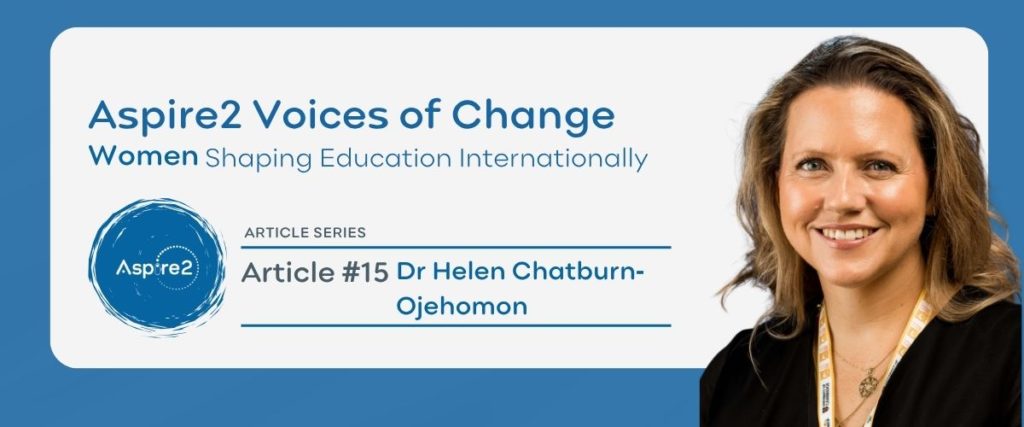
Dr Helen Chatburn-Ojehomon is Deputy Head of School at Ibadan International School, Nigeria, and an experienced international educational leader, researcher and systems thinker.
Holding a Doctorate in Education, Helen is passionate about educational leadership, teacher agency, student wellbeing and building inclusive school communities where every learner experiences belonging and opportunity.
Through her leadership and research, she advocates for human-centred education that strengthens school culture and creates lasting impact for students, educators and communities.
What inspired you, as a woman, to take the step into educational leadership?
This is a really interesting question because I cannot, in all honesty, claim that, at least initially, stepping into educational leadership was a conscious decision on my part. I can, however, look back and see that after a few years in the classroom, I knew I wanted to influence the bigger picture of teaching and learning. At the time, I did not realise that what I was yearning for was leadership. It took me much longer to recognise that there comes a point in many women’s careers where we are, in fact, stepping into leadership.
In mentoring other women, I can see that same leadership blindness in many. It is risky for women to openly yearn for power or authority, so many of us do not frame our ambitions in those terms. Instead, there is the drive to want to participate more deeply and fully, and have more voice and ability to direct the bigger picture. That was what inspired me and led me to gradually claim leadership consciously. Critically, I stopped seeing leadership as something other people granted me permission to do and began to actively pursue it for myself. I recognised the openings, stepped onto those paths, and I continue to pursue that journey.
What achievements in your leadership journey make you most proud?
Recently, two former students, both now young professional women, visited my school and sat down with me to talk about their lives. One is now an emergency medicine doctor and the other is a practicing therapist with her master’s in psychology. As we spoke, they reflected on their time at my school and shared how they had often thought about me, our school, its leadership, and the values they learned there during their foundational years.
These are the achievements that I am most proud of. Some of the work I value most is the invisible work: culture-building, mentoring teachers and students, strengthening and developing a community, and creating lasting human impact. When former students return as thoughtful, compassionate adults, you realise that education is deeply generational. It is a privilege to reach a point in my career where I can begin to see those long-term returns.
I am a systems thinker, and I often reflect on how the actions I take in leadership will outlast me. If the systems and cultures we build continue nurturing people long after we are gone, then I think we can be very proud of our leadership.
What challenges have you faced as a woman in leadership, and how have you navigated them?
Trying to balance competing and often contradictory demands is a daily struggle for women leaders, and it is something I have experienced intensely. I think one of the greatest challenges for women leaders is navigating contradiction. We are often expected to constantly calibrate ourselves around impossible standards of not being too much or too little.
Over time, I have come to realise that leadership does not require perfection, and I am actively trying to let go of any expectations rooted in perfectionism. I also think women are often held to a higher standard than men in many professional spaces, which can be both deeply frustrating and unfair. Earlier in my career, I internalised many of these pressures and attributed them to personal inadequacy rather than recognising the structural inequalities that shape women’s experiences in leadership.
One of the things that has helped me most has been finding communities of women leaders who openly share these experiences and support one another in navigating them. There is something deeply reassuring about realising these challenges are not individual failings, but rather part of broader systems and expectations that many women are still working to challenge and change. I think it is important that we continue naming these realities rather than accepting them as simply the cost of leadership for women.
How do you feel women leaders are influencing the future of education today?
I believe women leaders are helping define a new era in education. Working in Nigeria, where education is evolving rapidly, has made me especially aware of how complex and multidimensional educational leadership has become. My research into leadership in international schools and teacher agency in Nigeria highlighted the growing prominence of women leaders, and I see that same shift happening globally.
Some of the key themes I see shaping the future of educational leadership are the increasing professionalisation of the role, the growing importance of relational and community-centred leadership, and the need for leaders to navigate complexity across multiple domains simultaneously. Educational leadership today requires the ability to move fluidly between pedagogy, wellbeing, safeguarding, operations, policy, and culture-building, often all at once.
I also think women often carry much of the invisible relational and cultural work within schools and communities. Encouragingly, many of the qualities once dismissed as “soft skills” are now being recognised as essential leadership capabilities. The ability to build trust, sustain relationships, and hold communities together is increasingly valued, and I believe the growing visibility of female leadership is reshaping not only who leads schools, but also how leadership itself is understood and practised.
What message or advice would you share with the next generation of women aspiring to lead in education?
I think the best advice I have heard about educational leadership came from Diane Longboat, an Indigenous Elder, Traditional Healer, and founder of the University of Toronto’s First Nations House. I once heard her say, “Step into your leadership”, and I think that is one of the greatest pieces of advice a woman can receive.
For many women, stepping into leadership means crossing a threshold where you may need to leave behind comfortable relationships, familiar patterns of work, or older versions of yourself. That can be really difficult, and for some it takes a long time. Women taking on leadership roles offends some people. It not only changes dynamics at work, but also sometimes changes dynamics in families, friendships, and other personal relationships. All of this can be really challenging to navigate, and sometimes we may doubt if it is worth it.
I think this is why it’s essential for women to find and build strong communities of support, and sometimes that means creating those spaces ourselves. Leadership requires self-awareness, reflection, emotional understanding, resilience, and lifelong learning.
For aspiring women leaders, I would say: step into your leadership, get to know yourself deeply, build your own ecosystem of support, and never stop learning.
Tell us about a project, initiative or topic you are passionate about.
One area I have become increasingly passionate about is the role schools can play in supporting student mental health and wellbeing, particularly in contexts where stigma around mental health, neurodiversity, and learning differences remains significant. I believe schools have enormous potential to become places of understanding, belonging, and early support when leadership takes responsibility for the broader conditions that shape student wellbeing.
In my own leadership practice, I have reflected on how easily schools can unintentionally create tokenistic systems of support, in which well-being becomes isolated within a single department rather than embedded across the wider school culture. I have focused on building networks of support through teacher development, safeguarding structures, parent education, community partnerships, and creating environments where students feel known and supported by multiple adults around them.
Working in Nigeria has also reinforced the importance of contextual leadership in this area. Conversations around mental health and inclusion cannot simply be imported from elsewhere without understanding local realities, family dynamics, and cultural perceptions. For me, this work is ultimately about building schools that are deeply human places where young people can develop not only academically, but also a strong sense of identity, belonging, and possibility.