
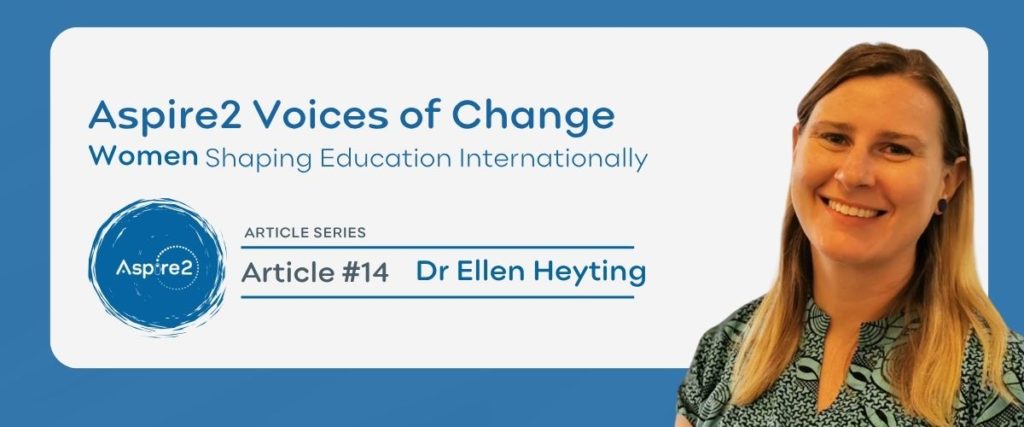
Article #14 – Dr Ellen Heyting
Dr Ellen Heyting is the International Networks Lead at Melbourne Metrics in the Faculty of Education at The University of Melbourne. A Senior Research Fellow and experienced educator, she has over a decade of teaching and leadership experience across IB World Schools in Melbourne, Beijing, Singapore and Helsinki, and is a member of the IB Educator Network (IBEN). Ellen holds a PhD in Education from Monash University and is a Fellow of the Higher Education Academy and the Australian Council for Educational Leaders. Her work focuses on teacher identity, learner agency and the assessment of complex competencies, and she is passionate about empowering educators and learners through innovative, future-focused education practices.
What inspired you, as a woman, to take the step into educational leadership?
When I reflect on my pathway into leadership, I realise how profoundly I have been shaped by the women (and man) who raised and surrounded me; my mum, dad and three grandmothers, while all very different types of role models, each showed me a different form of leadership and contribution.
My mum was an international senior executive in law firms, professional services firms and the UN, and showed me the real impact you can have when you find purpose in your profession. One of my grandmas was an Olympic medal swimmer and still holds world records for the 100-yard (cheating a little bit as it was right as they changed to meters) freestyle and backstroke and showed me the power of working hard and persevering. Another grandma (really a great aunt) was the head of finance for a large national company at a time when women’s pay was pegged to half a graduate man’s salary, no matter their position, teaching me an uncomfortable lesson at a young age about the inequalities and power structures that pervade our world. My other grandmother left her controlling and abusive husband while pregnant with my mum, an extraordinary act of independence and conviction for that time.
I was also inspired by my dad, who tag-teamed in the role of primary carer with my mum as I was growing up. I saw him be a successful entrepreneur, building the flag poles on the top of the Sydney Harbour Bridge (as well as lots of other long, thin, tall things made of metal), as well as being a caring, nurturing, supportive father and husband. Both my parents were wonderful examples, that hard work, determination, compassion and support transcend gender and it shaped the quiet architecture of my worldview.
Growing up across international school communities exposed me to diverse models of leadership, reinforcing that it takes many forms and is defined more by purposeful action than title. I’ve also been fortunate to work with leaders who saw more in me than I initially saw in myself. Their mentorship instilled a belief that leadership is a multiplier; when someone opens a door for you, you learn to do the same for others.
What achievements in your leadership journey make you most proud?
Completing my PhD while working full-time is one of my proudest achievements. It required sacrifice and persistence whilst deepening my understanding of belonging, identity and equity in education, areas that continue to shape my work. I often encourage others to pursue deep expertise in whatever form feels authentic; it’s the thinking process that matters most.
I’m also proud to contribute to leading approaches in assessment, particularly around transferable learning capabilities like agency, collaboration and quality thinking through my work with Melbourne Metrics and the New Metrics movement. This work shifts the focus from what students know, to what they can do, contribute and create.
Finally, I take pride in saying “yes” to meaningful opportunities, mentoring, research collaborations, professional learning and community initiatives. These experiences have connected me with diverse communities and reinforced my belief that generosity is a vital leadership practice.
What challenges have you faced as a woman leader, and how have you navigated them?
I thought I understood challenges until I became a parent. Nothing prepares you for the profound recalibration that comes with trying to nurture a couple of small humans while also contributing meaningfully to your profession. The sleepless nights, the ongoing tug of war between presence and productivity, and the ever present “mum guilt” make leadership feel heavier on some days than others. This is not a story unique to me; it echoes across the experiences of so many women leaders featured in the Voices of Change series, who speak candidly about navigating competing pressures with courage and grace.
What has sustained me is the extraordinary network around me: family, friends, colleagues and mentors. Accepting help, sometimes reluctantly, has been essential. I once believed strength meant doing everything myself; now I know it means recognising the village around you, being grateful for that support and honouring it by bringing your full self to whatever is in front of you. This shift has shaped how I lead, especially in supporting others who are navigating complex lives behind the scenes.
I’ve also learned to advocate more strongly for trust, flexibility and empathy within the systems I work in. I’m fortunate to work with leaders who model this, creating environments where people have the trust and agency to work in ways that suit them. Leadership must make space for real life, not hide it. My experiences have strengthened my commitment to building cultures where people feel safe to be themselves, where care and rigour coexist, and where no one needs to diminish who they are to lead.
How do you feel women leaders are influencing the future of education today?
We are in a moment of significant transition, one where women leaders are excelling in all the capabilities education claims to value: academic expertise, collaboration, critical thinking, creativity, empathy and systems level insight. Yet, despite this strength, women remain underrepresented in senior leadership roles globally. This gap does not reflect capability; it reflects long standing structural and cultural patterns that our generation is working hard to disrupt.
Women leaders today are reshaping education by modelling leadership that is values driven, relational and future focused. Many of us challenge traditional hierarchies, champion learner centred approaches and design environments where teachers feel trusted as professionals.
I believe women leaders are also influencing education through the power of visibility. The more we see women leading boldly, across schools, systems and thought leadership spaces, the more possible leadership becomes for the next generation. Representation is not symbolic; it is catalytic. And the impact of women leaders today will echo through the careers and choices of the young people watching us.
What message or advice would you share with the next generation of women aspiring to lead in education?
First, develop your enduring human skills. As education continues to navigate the rise of AI, automation and digital transformation, the leaders who will matter most are those who can connect, empathise, listen, negotiate complexity and build trust. Nobody wants to be led by a bot. The future will always require proudly and deeply human leadership.
Second, become an expert; go deep in something that sparks your curiosity. Expertise doesn’t have to mean a PhD; it just means allowing yourself to specialise, to be the person others seek out for insight, perspective or guidance. Depth gives you confidence, credibility and clarity, and you never know where a rabbit hole of expertise will take you. When I started my PhD journey, I thought it was going to be my developing expertise in belonging that people would seek me out for. Through that experience, I had to learn a lot about construct validation, measurement and assessment; knowledge and know-how that now extends beyond the belonging literature and has become an area of expertise all on its own. My own path through research, leadership and assessment has shown me how powerful it is to anchor your leadership in something you care deeply about enough to explore fully.
Finally, back yourself. Leadership is not bestowed; it is enacted. If you wait until you feel ready or for someone to tap you on the shoulder, you will miss opportunities. Step forward, ask questions, contribute generously to the initiatives of those around you and surround yourself with people who will back your growth as fiercely as you back theirs. And when you find spaces that don’t recognise your value, remember you have the agency to build or join others that do.
What are of your work would you like people to know more about?
If there is one area of my work that I wish more people knew about, it is the transformative potential of the Melbourne Metrics approach to assessment. At its heart, Melbourne Metrics is about leveraging the power of assessment to transform schools into places where people develop the competencies they need to thrive at school and beyond. We value what we measure, so we think it’s time we measure what we value. Competencies like agency, collaboration, creativity, acting ethically and active citizenship. These competencies are essential not only for flourishing while at school, but for contributing meaningfully to communities, workplaces and society as a whole.
For too long, education systems have prioritised narrow measures that capture only a fraction of human potential, such as an ATAR score, a DP score, a NAPLAN result or similar. Melbourne Metrics exists to change that narrative, drawing on research and global partnerships to design evidence based, future focused alternative profiles of competence.
For me, this work is not just technical and about designing new assessments; it is deeply hopeful and has the power to transform an education system that has remained largely unchanged for over a century. When we measure, recognise and celebrate what we value, we open doors for young people who have been historically underserved by conventional measures, not to mention begin to dismantle the malaise of mental health issues that the stress of current metrics cause young people in their final years of schooling. By focusing on these enduring human skills, we’re not only sending a powerful message to all stakeholders about what matters in education, but we empower learners to understand themselves as capable, creative and agentic full humans who are needed to contribute towards broader human and planetary flourishing.