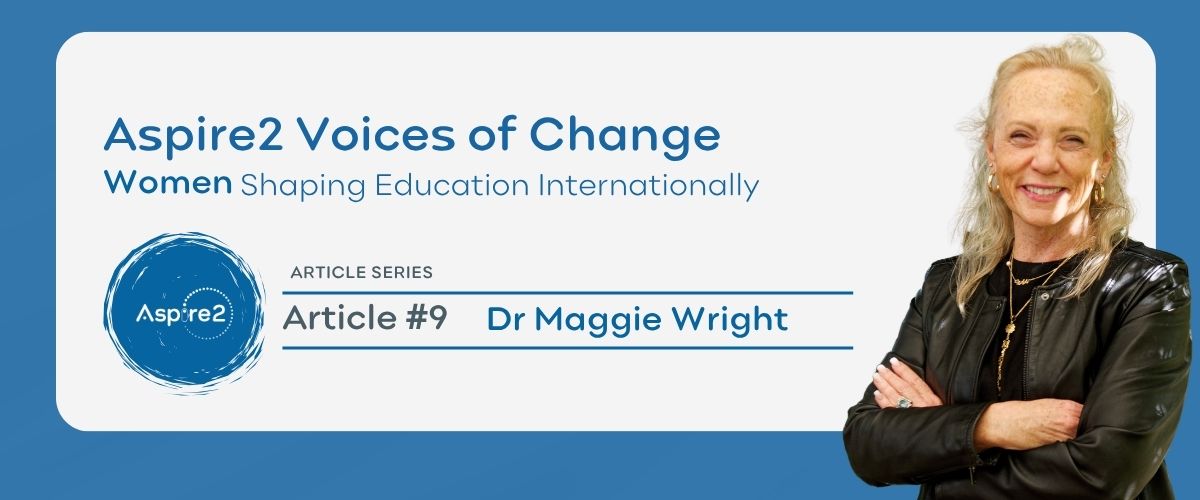
Aspire2 Article Series: Voices of Change, Women Shaping Education Internationally
Article #9 – Dr Maggie Wright
Dr Maggie Wright is an international education leader with extensive experience across many continents, holding senior executive roles in large multi-school organisations. Her work spans school improvement, organisational transformation, and cross-functional leadership, integrating education, operations, governance and sustainability.
Maggie holds a Professional Doctorate focused on evidence-informed leadership and decision-making in educational leadership, shaped by a belief that authentic leadership is at the heart of meaningful school improvement. Her research and practice explore how leaders navigate complexity with integrity, balancing moral purpose with thoughtful systems and reflective discipline.
She is passionate about supporting leaders to know themselves as well as they know their strategy and to lead with clarity of values, courage and humility. For Maggie, authentic leadership is not about performance or position, but consistency between what we say, what we decide and how we show up for our school communities. She believes that lasting school improvement happens when leaders create cultures of trust, accountability and collective responsibility, always keeping students at the centre of every decision.
1. What inspired you, as a woman, to take the step into educational leadership?
I care deeply about the lived reality of schools, the hopes of students, the dedication of teachers and the trust families place in us every day. Early in my career, I saw how often key decisions were made far from classrooms, and how easily the human dimension of education could be overlooked. As a woman, I also noticed how power, voice and influence were unevenly distributed. I witnessed how thoughtful, values-driven leadership could radically change the experience of a school community. That realisation inspired me to make a positive difference. Leadership became a way to advocate for fairness, quality and integrity. Over time, leading became less about authority and more about stewardship, creating conditions where others can thrive, and where learning communities are guided with integrity, clarity and compassion.
2. What achievements in your leadership journey make you most proud?
My pride cannot be reduced to a single role, title or deliverable. Across international contexts, I have led large-scale school improvement, organisational transformation, and cross-functional integration, always with a focus on long-term impact rather than short-term gains. The moments that stay with me are the human ones: helping a school regain stability; supporting leaders through moments of doubt; or seeing teams grow in confidence and competence. I am especially proud of the women I have mentored and sponsored – watching them find their voice, step into leadership and redefine it on their own terms. Overall, it is the quiet, cumulative impact of building sustainable systems that work and continue to work after I step away.
3. What challenges have you faced as a woman leader, and how have you navigated them?
I have navigated environments where expectations were often unspoken and standards unevenly applied. There have been times when my assertiveness was misinterpreted, complex realities reduced to simple narratives and resilience was expected rather than actively supported. Over time, I learned to respond with discipline rather than defensiveness by grounding myself in evidence, anchoring my decisions in values, and cultivating deep self-awareness. I became intentional about how I lead, how I communicate, how I make decisions and how I protect my own well-being. One of the most important lessons I have learned is that sustainable leadership requires boundaries. Caring deeply does not mean carrying everything alone. In fact, modelling balance, clarity and self-respect gives permission for others to do the same. Protecting one’s wellbeing and sense of self is not a weakness; it is an act of leadership and one that enables me to lead with courage, integrity and longevity.
4. How do you feel women leaders are influencing the future of education today?
Women are redefining what strong leadership in education looks like. We are combining courage with compassion, strategic focus with relational depth, and accountability with authenticity. In a sector that sits at the intersection of purpose and performance, that combination matters. Gender should be irrelevant. Leadership is determined by character, competence and conviction. The real influence we are having is expanding the definition of leadership itself, demonstrating the coexistence of empathy and excellence, commercial clarity, and moral purpose. What matters most is developing and supporting all leaders, men and women, who combine strategic rigour with humanity. Women leaders today are modelling that balance and, in doing so, shaping a more balanced and resilient future for education.
5. What message or advice would you share with the next generation of women aspiring to lead in education?
You do not need to have everything figured out before you step forward. Most importantly, know your values and stay anchored in them. There will be moments when integrity feels costly, but it is also what sustains you over time. Our perspective matters precisely because it is shaped by experience, empathy and reflection. Our voice matters, not because it is flawless, but because it is authentic and grounded in purpose. Leadership is learned through doing, reflecting and sometimes getting it wrong. Seek mentors who tell you the truth, not just what is comfortable to hear. Invest in your own learning and take your thinking seriously.
6. What are you most passionate about?
My own values have been informed and grown through my passionate advocacy for authentic leadership and the use of reflective frameworks to improve educational outcomes. I have been able to develop and document this passion through my doctoral research and professional work. My focus is on how leaders improve student outcomes and make decisions, and how personal beliefs, school culture and data literacy shape those decisions. I am convinced that the next phase of educational leadership must move beyond intuition alone and embrace disciplined reflection, triangulated evidence, and ethical accountability. When leaders combine moral purpose with analytical rigour, schools become not only places of learning for students but learning organisations for adults as well.