
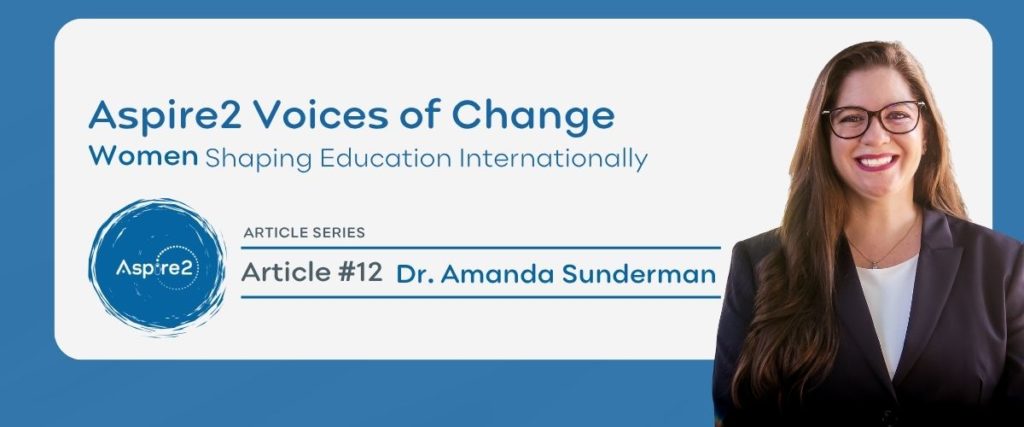
Article #12 – Dr. Amanda Sunderman
Dr. Amanda Sunderman is the Director of The American International School of Vilnius and a CEESA Board Member. With extensive experience in international education, she is passionate about creating challenging and engaging learning environments for students while supporting and learning alongside colleagues. Amanda is driven by a strong belief in intentional leadership, hard work, and fostering creativity within school communities.
What inspired you, as a woman, to take the step into educational leadership?
My journey into leadership started with a shoulder tap.
A school I was working at needed someone to take on a leadership role of supporting the school with the Council for International Schools (CIS) accreditation report. As a young leader, I had good instincts but limited formal training in educational leadership. After two years in leadership, I went back to teaching, which I felt was my life’s calling, and I loved being a teacher again.
As I observed the dynamics of leadership in a larger school and the power that leaders have to make a positive difference, I felt motivated to return to leadership, this time with a stronger foundation of training. Good leaders help communities navigate and innovate through both challenging and stable times. I firmly believe communities need leaders who recognise the weight of their responsibility, care with authenticity, and are willing to engage deeply with those they serve.
What achievements in your leadership journey make you most proud?
Three major areas come to my mind.
- Creating Opportunities
In international schools, we often work with families with a great deal of resources. It has been a privilege to strive to create opportunities for families with less resources through initiatives such as increasing scholarship opportunities in my last two schools, earthquake relief efforts, and supporting over 40 staff and families with emergency housing post-earthquake. Other opportunities include working with a major donor, Muhtar Kent, to open the Misak-i Milli Muhtar Kent Stem Center at Tarsus American College. This created incredible opportunities where we collaborated with Muhtar Kent, school alumni, and the Tarsus Municipality to host annual summer STEM camps for hundreds of economically disadvantaged students.
- Guiding Communities Through Crises
In my years in senior leadership, I have helped communities to navigate crises such as natural disasters, political instability, child protection cases, and the loss of beloved community members. I do not believe in saying bad experiences happen for a purpose, but I do believe that good leadership can help communities navigate turbulent times and come out stronger and more deeply connected. There is great power in human connection as we all navigate the challenges, sorrows, and joys of life.
- Cultivating a Sense of Belonging
Lastly, I am proud of being able to connect deeply with stakeholders. Sometimes, years later, an individual gets in touch, and it inspires me to continue to have as much face-to-face time with my school community as I can manage. It means a lot of my project and email work happens at odd hours, but I love being a part of creating belonging in a school community. It takes intentionality, conversations, engagement, and a lot of listening.
What challenges have you faced as a woman leader, and how have you navigated them?
Is this a good place for a laughing/crying emoji?
- My gender – I have been told to my face that the board would never consider a female for the director role (obviously not at my most recent schools). I finished my contract there because quitting immediately would not have impacted those above me, but the teachers and students who relied on my work and leadership. I also see how there are many female school principals, but very few female directors.
- Imposter syndrome – this used to weigh heavily on me, and I felt I had to tick every box to consider applying for a job. Doubting that my rapid career ascension might not be good enough, and that just one more certification would prove I was enough. I have let go of imposter syndrome, and I try to lead with confidence and humility; they are beautiful partners.
- My appearance – used to come up a lot. I was constantly asked my age, as if being a certain age could somehow make me credible. I started having fun with that question by offering to share my face cream brand, telling people my age, but then asking how old they were. What I loved was that some people saw the humour and reflected, while others were aghast that I would dare to ask their age! In a sense, I used some good-natured humour to hold up a mirror to people’s questions.
- I have had advantages too – it is worth shining a light on the incredible challenges faced by my colleagues who are BIPOC leaders. When one examines the demographic statistics on leaders of international schools, I am part of a very small group, but my BIPOC colleagues are an exponentially smaller group. Our students need to see themselves represented in every part of the community around them.
How do you feel women leaders are influencing the future of education today?
Someday, I hope a question like this can just be how do leaders influence the future of education because it will mean that my gender is not an integral part of my leadership identity, that instead my leadership identity is about my moral compass, work ethic, ability to connect with others, navigate crises, and cultivate beautiful and bold futures for students. But in the short term, I believe we are showing that women are capable of performing at the highest level, not as an exception to the norm but as deeply skilled humans. I believe we are influencing young people and potential future leaders to define their future by their passions and capabilities.
What message or advice would you share with the next generation of women aspiring to lead in education?
There is a place deep within, some may call it your inner compass. The name does not matter, but find this deep inner self, who you are and what you believe about the work you are doing with the humans in your sphere of influence. Use this inner compass to guide and strengthen your leadership. Let go of imposter syndrome. Find a balance of preparedness and acceptance that you are absolutely enough. Say people’s names in spaces they do not have access to, nurture talent, and be a creator of opportunities.
What is a project, initiative or topic you are passionate about?
Getting into international education has been the privilege of a lifetime. I have become a better human in so many ways, but I would like to challenge myself and other international schools.
We often work with a great deal of economic privilege.
- How can you start, even with micro actions, to create opportunities for students in your community who could never afford your school?
- What does it mean to truly live your school’s mission and vision?
- What steps can you take next?
- What if every international school in the world gave even one child a full-ride scholarship?