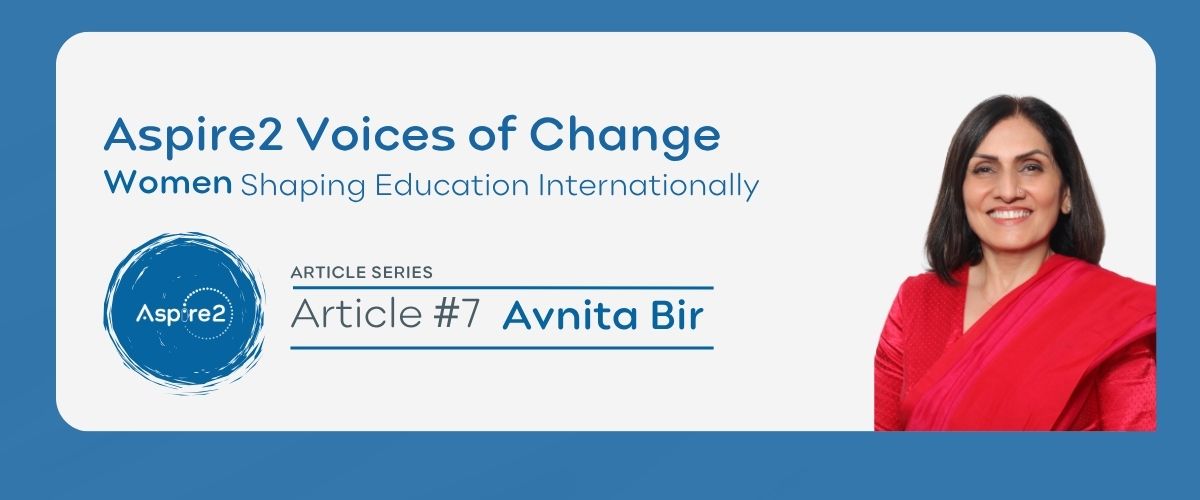
Aspire2 Article Series: Voices of Change, Women Shaping Education Internationally
Article #7 – Avnita Bir
What inspired you, as a woman, to step into educational leadership?
Education is a deeply human profession built on relationships, behaviour and trust, yet it has changed remarkably little since the industrial age. While most professions have embraced collaboration and innovation, teaching often still operates in silos, with educators working alone rather than as part of integrated teams.
I have felt the growing gap between the rapid change outside the classroom and the relative stagnation within it. Although we speak about personalisation, much teaching still targets the “average” learner, leaving many students either disengaged or unsupported.
What inspired me to step into leadership was the enormous opportunity for impact and the chance to reshape how we think about teaching and learning. I was driven by the belief that educators should see themselves not just as deliverers of content, but as designers of meaningful learning experiences.
Changing mindsets, restoring professional dignity and reimagining what education can be has become my mission, and it continues to energise me every day.
Which achievements in your leadership journey are you most proud of?
My greatest sense of achievement comes from recognising that leadership is a journey of continuous learning, growth and evolution. Early on, I realised that to lead well in education, I first had to remain a learner myself. We are all works in progress.
I became a close observer of systems, people and context, staying connected to the experiences of students, teachers, parents and leadership teams. This helped me identify challenges early and respond with solutions that were both effective and empathetic.
One area where this made a real difference was in the creative use of technology as a problem-solving tool. It allowed us to personalise learning, build trust among stakeholders and remain agile in times of change.
What gives me the most pride today is the collective mindset we have built, a shared belief that growth is always possible. I see teachers who once hesitated now confidently designing new learning experiences, students who are not only academically capable but emotionally secure and socially aware, and parents who feel that school is a true partnership.
If I have achieved anything meaningful, it is helping create a culture where growth feels safe, curiosity feels natural, and innovation is about reimagining tradition, not replacing it.
What challenges have you encountered as a woman leader, and how have you navigated them?
The most significant challenges I faced were not overtly gender-based, but linked to the rigid, risk-averse mindsets that can exist within education. Many experienced professionals rely on familiar approaches and resist change, even when evidence points to the need for new thinking. Technology was often viewed as a threat rather than a tool, and professional learning felt top-down and disconnected from classroom realities.
We addressed this by reframing teachers as designers of learning. Through a “Teacher Innovation Cycle,” teachers were empowered to propose, pilot and present new ideas. This shifted perceptions and technology became a tool for growth, whilst teachers began to see themselves as innovators.
Leading change meant gently unsettling comfort zones, not because of a lack of passion, but a lack of exposure to possibility. Introducing innovation required patience, persistence, and an unwavering belief in long-term impact. I learned that leadership in education is not about authority, but about walking alongside people as they unlearn, relearn, and rediscover their potential.
That said, subtle gender bias did surface at times, particularly in leadership spaces where some domains were implicitly seen as “male.” Navigating this required quiet resilience, clarity of purpose, and trusting that competence speaks louder than convention.
Sustainable change in education is not achieved through force, but through consistent demonstration, dialogue, and trust-building.
How do you see women leaders influencing the future of education today?
Women leaders are already highly visible in education, and I believe their influence will continue to grow. Technology and the internet have levelled access and opportunity, removing many of the barriers that once limited participation and leadership.
As more educators move beyond their initial apprehension toward technology, I see a powerful shift taking place, increased confidence, empowerment, and professional pride. Once that fear barrier is crossed, women leaders are uniquely positioned to drive transformation across pedagogy, leadership, collaboration and innovation.
I believe we are on the cusp of a surge in meaningful educational advancement, led by women who are rethinking, redesigning and rehumanising learning, shifting from control to connection, hierarchy to humanity, and competition to collaboration. Women leaders understand that education is not only about academic success, but about nurturing confident, compassionate and resilient human beings.
They bring a strong blend of empathy, collaboration and creativity in a world flooded with data. Educators play a critical role in helping students distinguish noise from meaning, facts from opinion, and information from true knowledge.
What message or advice would you offer to the next generation of women aspiring to lead in education?
To every young woman who dreams of leading in education, I would say, do not wait for perfect confidence. Lead while you are learning.
There will be moments of doubt, times when change feels lonely, and when resistance makes you question yourself. In those moments, remember that leadership is not about fitting into expectations; it is about expanding horizons. In education, the most powerful leadership is not about authority; it is about impact.
Own your vulnerabilities. Be fearless. Trust your creativity. Most importantly, challenge the stereotypes that limit your profession and yourself. Do not accept inherited boundaries as fixed truths. Education needs leaders who are willing to question, experiment and evolve. When you lead with conviction and integrity, you create space for your own growth and for the growth of others.
Remember that discomfort is often the doorway to growth. Disequilibrium is not a sign that something is wrong, it is the unsettlement needed before a higher equilibrium can form. Lead with the belief that every challenge is an opportunity to become a more creative problem solver.
A personal passion: Changing mindsets, not just methods
If there is one area I am deeply passionate about, it is transforming how educators see themselves. Over the years, I have met many talented teachers who simply needed someone to believe in their potential before they believed in it themselves. Some of my most meaningful moments have been hearing a teacher say, “I never thought I could do this, but now I cannot imagine teaching any other way.”
Through initiatives in personalised learning, flipped classrooms and social innovation, my focus has always been less on tools and more on thinking, because when thinking changes, everything changes.
I often say, buildings do not make great schools.
Curriculum does not make great schools.
People do.
And when you empower people to grow, you do not just improve education, you shape the future.