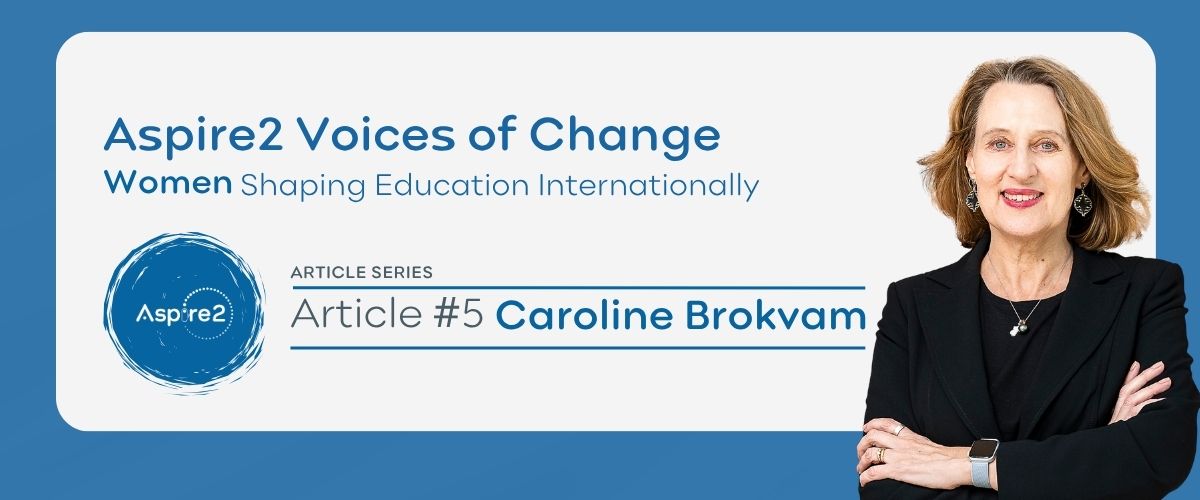
Aspire2 Article Series: Voices of Change, Women Shaping Education Internationally
Article #5 – Dr Caroline Brokvam
Principal, International School of Western Australia
Caroline is currently the Principal of the International School of Western Australia and brings over 20 years of experience in diverse, community-minded international schools. She previously served as the Director of the American School of Antananarivo, an International Baccalaureate World School in Madagascar, and has also held leadership and teaching roles at International School Stavanger, International School Manila, and Copenhagen International School.
What inspired you, as a woman, to take the step into educational leadership?
My inspiration to lead comes from the profound impact education can have on students and, in turn, on communities and future generations. Empowering young people, seeing them overcome challenges, and watching their confidence grow is incredibly motivating. I wanted to help create schools where students experience joy in learning, feel heard, and are supported to succeed. As a woman, I’ve also seen how representation matters; I wanted to model a leadership style that is collaborative, compassionate, and committed to equity, and to show that traditional notions of leadership can evolve. My journey has taught me that leadership is about saying yes to opportunities, embracing challenges, and staying open-minded, resilient, and committed to continually improving the student experience.
International schools have also been a source of inspiration. Their diversity enables them to embrace multiple perspectives and address global challenges in meaningful ways. Research consistently shows that diverse teams outperform homogenous ones, and international schools cultivate this strength by nurturing global citizenship, shared humanity, and collaborative problem-solving. Diversity is a powerful asset and leading schools that embrace it allows education to play its vital role in making the world a more peaceful and connected place.
What achievements in your leadership journey make you most proud?
Leading in international education brings both challenges and immense rewards, and my proudest achievements come from navigating complexity while keeping students at the centre. Working across countries and cultures demands rapid adaptation, and Drucker’s reminder that “culture eats strategy for breakfast” is never far from mind. Beyond cultural nuance lie the ongoing pressures of finance, staffing, enrolment, global uncertainty, technology, sustainability, and wellbeing. Leading through COVID-19 was a defining experience. As schools closed and communities dispersed, we focused on maintaining connection, continuity, and hope. Those moments reinforced the importance of agility, empathetic decision-making, and finding creative ways to keep our community united even when buildings were empty.
I am also deeply proud of building strong cultures of belonging in transient international school environments. At ISWA, prioritising wellbeing, inclusion, and diverse perspectives ensures that students, families, and staff feel connected from the moment they arrive. Creating environments where inquiry, creativity, and student voice drive learning has been particularly rewarding, as has watching students grow in confidence and global awareness. These experiences continue to shape my belief that strong leadership is not about having all the answers, but about creating the conditions for people to contribute, innovate, and thrive. That is the achievement I value most.
What challenges have you faced as a female leader, and how have you navigated them?
As in many industries, one of the biggest challenges I have faced as a woman in educational leadership is being in the minority. It can be isolating, and at times it takes more effort to have your voice heard or to be considered for opportunities that may come more readily to male colleagues. There are moments when perceptions differ and qualities such as assertiveness, often praised in men, are interpreted differently for women. Navigating these dynamics demands confidence and resilience. There is also a lingering expectation that women should be both nurturing and decisive, which can be a difficult balance to strike. Over time, I have learned that authenticity and consistency matter most. Showing up each day with the same values builds trust and dispels doubt.
One of the most important supports in my journey has been a strong network of women leaders in international education. These relationships provide encouragement, advice, and a safe space to share experiences. I also want to acknowledge that many men have believed in me and championed my leadership along the way, and their advocacy has opened important opportunities. That combination of support has been invaluable. I do think progress is being made and that diverse leadership styles are increasingly recognised and valued. By being visible, authentic, and confident in how I lead, I hope I can encourage others to step forward and see themselves in leadership too.
How do you feel women leaders are influencing the future of international schools today?
Women leaders are reshaping the future of international schools by bringing diverse perspectives, collaborative leadership styles, and a strong focus on inclusion and wellbeing. Their emphasis on empathy, shared decision-making, community building, and elevating student voice is helping create environments where young people feel heard, valued, and empowered, directly supporting the mission of international education to develop globally minded, culturally capable citizens.
They are also driving a shift toward holistic education by prioritising wellbeing, sustainability, and broader measures of success that nurture resilience and adaptability. As more women and minority leaders step into senior roles, they become powerful role models and contribute to more balanced leadership teams, an advantage proven to enhance innovation and decision-making. Their leadership is central to building the collaborative, diverse, and future-focused schools our world needs.
What message or advice would you share with the next generation of women aspiring to lead in education?
My advice to women aspiring to lead in education is to just keep going, even when the path feels uncertain. Leadership is rarely a straight line; it’s a series of opportunities, challenges, and moments where you choose courage over comfort. Say yes to opportunities, even when you don’t feel ready, because growth happens in those spaces. Embrace challenges as learning experiences, remain open to possibilities, and prioritise relationships: they are the foundation of effective leadership. Listen deeply, speak with intention, and always ground your decisions in what you sincerely believe is best for students. There will be competing demands and pressures, but if you keep students at the centre, you will not lose your way.
I’ve seen positive change during my career: more women and minority leaders, more championing of diverse voices, including student voices. This momentum matters, and we need you to keep it going. Representation is powerful, and when you lead authentically, you show others that leadership can be collaborative, compassionate and strong.
Finally, remember that the impact you make as an educator extends far beyond the classroom. You are shaping the leaders, thinkers and citizens of tomorrow. That is an extraordinary responsibility and privilege. So really, what choice is there but to keep trying? Believe in your voice, build your network and lead with purpose. The future of education needs you.
What key project, initiative or topic are you most passionate about?
I am particularly passionate about ISWA’s Visible Wellbeing program, developed by Professor Lea Waters. As education evolves, it must move beyond academics to help students build the skills and resilience needed to thrive. Visible Wellbeing provides a research-based framework that embeds wellbeing practices into everyday teaching and learning, focusing on six pathways: strengths, emotional management, attention and awareness, coping, habits and goals, and relationships. This approach empowers students to understand their strengths, manage emotions, and develop habits that support both academic and personal growth, while also giving staff practical strategies to model and sustain their own wellbeing.
In an international school setting, this initiative is especially powerful. By fostering emotional intelligence and empathy across cultures, Visible Wellbeing strengthens students’ ability to connect, collaborate, and flourish in a diverse global community, one of the most meaningful contributions we can make as educators.