
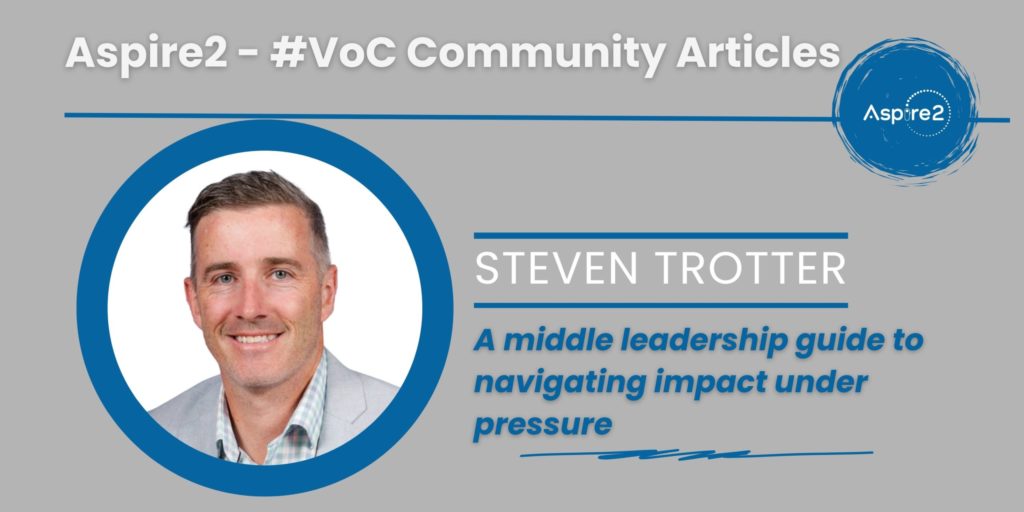
An extract from Steven Trotter’s book Stretch, publishing with Amba Press July/Aug 2026
“No leader you will ever follow is more important than the one you choose to become”
In my soon-to-be-published book, Stretch: A Middle Leader’s Guide to Navigating Impact Under Pressure, I explore the idea of the Stretch: the space in which a middle leader grapples with the need to lead and support their peers whilst feeling the demands and pressure from senior leadership. It is a position all leaders have found themselves in throughout their development, yet there is little in the way of structured, intentional adult leadership development that builds the capacity of those living in the Stretch. This book aims to change that.
‘Stretch’ is a concept that surrounds us every day. Our clothes stretch, our muscles stretch, and even our tyres rely on stretch to inflate and grip the road. This ability to expand, to flex and return, gives us strength, resilience and movement. It allows for durability and adaptability, qualities essential not just in materials, but in people too.
We all understand the act of stretching. We do it at the gym, before a run, or when tugging on an old pair of jeans that may have seen better days, or after the festive season. We stretch a hair tie, a balloon, a rubber band, and in my latter years, my belly has not been immune either. We also know what happens when we push that stretch too far, when we put too much pressure on an object. In physics, this is often framed through the concept of elasticity: the capacity of an object to return to its original size and shape once pressure is released. When my kids hand me a balloon and ask me to blow it bigger, with every extra breath, my mind wanders, picturing the sudden pop, the sting of rubber snapping back. The anticipation makes me feel like a risk-taker with every small extra puff, as my kids urge me to make it “bigger… bigger.”
We know that people are far more complex than a pair of jeans, a balloon or a rubber band. When we are stretched mentally, emotionally or physically, we may not simply return to our original state once that pressure is removed. Depending on the degree of pressure, recovery may take time and require intentional focus. In the simplest terms, overstretching leads to damage, and the magnitude of that damage varies across a wide range of individual factors. A rubber band is designed to stretch and then contract to hold pressure, but too much of either and it snaps. Function becomes failure, and the damage is irreversible. Stretch is not inherently bad; in fact, it is essential for many things to work effectively. What matters is an appropriate level of pressure, and the opportunity for that pressure to be released or increased depending on what the stretch requires.
For middle leaders, this is not a metaphor; it is a daily reality. I have come to call this experience the Stretch: the resistance between the classroom and the meeting room, between implementation and vision, between doing and leading. These leaders are constantly pulled in multiple directions, their roles stretched by competing priorities, expectations and demands. And, like a balloon, if that stretch becomes too great, we know what can happen next.
Leadership is, by nature, a high-pressure pursuit: demanding, dynamic and deeply human. Pressure is not our enemy. Research suggests that an appropriate level of pressure elevates performance, while too little or too much can each produce the opposite effect.