
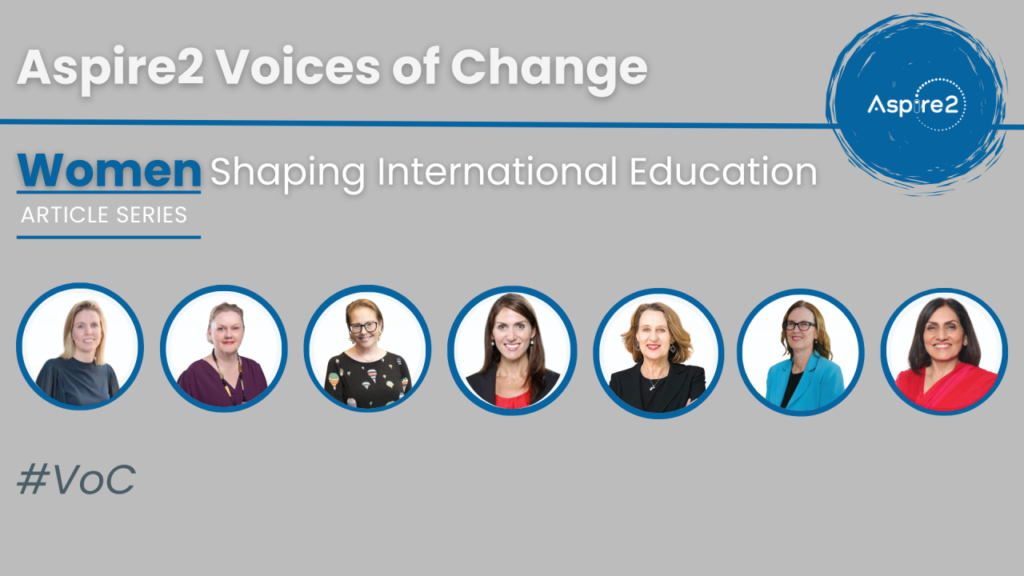
As Aspire2’s Voices of Change: Women Shaping International Education series continues, a powerful pattern is beginning to take shape. Through conversations with women leading schools and systems around the world, a shared story is emerging about what leadership in education is becoming and what it may need to be if it is to meet the future with confidence and care.
What has stood out to me most is that these leaders are not talking about titles or authority. They are talking about people, purpose and connection.
It is not just their individual journeys that matter, but the way the same ideas keep surfacing across each story. These themes are also appearing more frequently in wider education conversations, on LinkedIn and across professional learning communities. It feels as though a shift is underway.
Leadership is becoming much more human
Sian May speaks about the complexity facing today’s students and the responsibility leaders carry to prepare young people for uncertainty. Her focus is on community, values and partnership in a rapidly changing world.
Rachel Edwards reinforces this through her commitment to environments where students feel safe, heard and challenged. For her, leadership is about meeting people where they are and helping them grow.
Donnah Ciempka challenges the traditional image of the international school leader and reframes leadership as relational, authentic and deeply human.
Dr Angela Meikle adds another important layer by highlighting belonging, wellbeing and connection as central to the future of international schools. Her service-leadership approach shows that leadership is not only about direction, but about creating communities where people can flourish together.
Across all these voices, leadership is described not as control, but as care. Not as hierarchy, but as trust.
It is hard not to see how closely this mirrors what many of us are experiencing in schools today. Psychological safety, wellbeing and relational leadership are no longer optional. They are foundational.
Mindset matters more than methods
Another strong theme running through these stories is the emphasis on mindset over mechanics.
Dr Caroline Brokvam reminds us that culture shapes everything and that schools thrive when belonging and wellbeing are embedded into daily life. Her Visible Wellbeing work reflects a move beyond academic success alone towards whole-child development.
Joanna Povall’s Kind Leadership and CHASE framework reinforce that high standards and compassion can and must coexist. She shows that kindness is not soft leadership, but courageous leadership.
Avnita Bir takes this further by challenging industrial-age models of teaching and reframing educators as designers of learning rather than deliverers of content. Her focus on changing thinking rather than tools echoes strongly across the series.
Angela Meikle’s doctoral work on action research also aligns closely with this theme. She speaks about growth through small steps, reflection and collective efficacy, reminding us that improvement comes from learning cultures rather than quick fixes.
Together, these leaders point to a deeper truth. Sustainable change does not come from programs alone. It comes from how people see themselves and their role in learning.
Women are reshaping what leadership looks like
Another theme that runs quietly but powerfully through every story is the redefinition of leadership itself.
These women are not trying to replicate old models. They are expanding them.
They speak about empathy, collaboration, courage and clarity. They talk about walking alongside others, learning while leading and creating cultures where growth feels safe.
There is also honesty about challenge.
Rachel Edwards speaks of confidence gaps and advocacy. Donnah Ciempka speaks of not always being heard. Caroline Brokvam reflects on being in the minority. Joanna Povall shares the tension between leadership and motherhood. Avnita Bir acknowledges subtle gender bias and the patience required for change. Angela Meikle speaks openly about the double bind of being both decisive and likeable, and about the importance of support networks that make leadership sustainable.
Yet none of these women frame themselves as limited. Instead, they see themselves as responsible for shaping something better.
This reflects a broader shift we are seeing across professional networks, where women are increasingly defining leadership through impact rather than image.
Leadership as impact, not position
Perhaps the strongest shared belief across all these voices is this. Leadership is about impact.
It is about shaping cultures where teachers feel empowered. Where students feel seen. Where innovation is possible. Where wellbeing and learning can exist side by side.
Whether it is Sian May preparing students for complexity, Rachel Edwards developing others, Donnah Ciempka building community, Caroline Brokvam embedding belonging, Joanna Povall leading with kindness, Avnita Bir rehumanising learning, or Angela Meikle strengthening collective efficacy, the message is consistent.
“Leadership is not something you hold. It is something you give”…
Questions for reflection
- Together, these voices raise important questions for education systems everywhere.
- Are our leadership models keeping pace with the human needs of our schools?
- Do we value belonging and wellbeing as much as performance and outcomes?
- Are women supported to lead authentically, not just visibly?
- Are we still designing schools for the past rather than the future?
- What would change if we truly saw educators as designers of learning and not just implementers of curriculum?
Perhaps the most important question is this.
If leadership today is about connection, courage and community, are we willing to lead differently?
The Voices of Change series does more than spotlight individual leaders. It reflects a broader movement towards leadership that is relational, reflective and deeply human.