
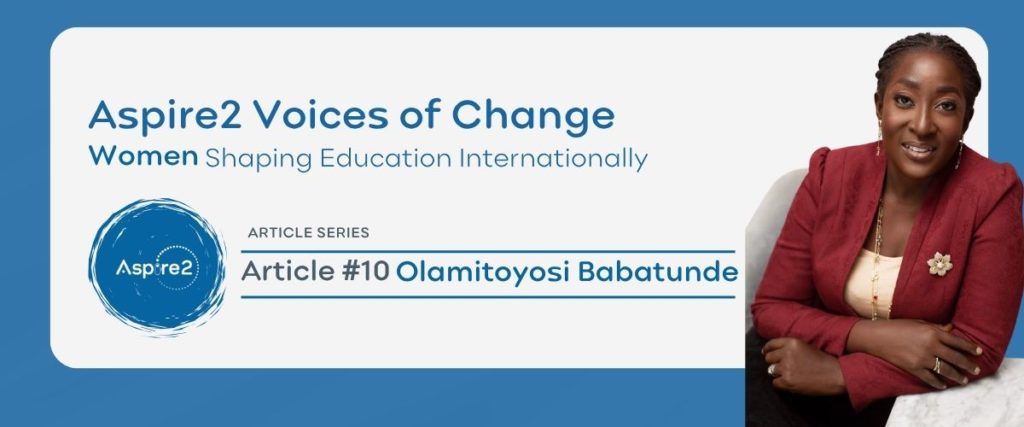
Article #10 – Olamitoyosi Babatunde
In this edition of Voices of Change: Women Shaping International Education, we feature Olamitoyosi Babatunde – an educational leader, consultant and capacity builder whose work spans classrooms, leadership programmes and cross-continental collaboration. With a leadership journey shaped by discipline, vision and a deep commitment to excellence, Olamitoyosi has dedicated her career to empowering educators, strengthening systems and creating environments where both learners and teachers can thrive. From advancing inclusive practice in Nigeria to convening global professional learning experiences, her work reflects a powerful belief: when educators grow, entire communities are transformed.
What inspired you, as a woman, to take the step into educational leadership?
I often say that educational leadership found me. As a young teacher, I made a quiet promise to myself that I would rise to the highest level my profession could offer. At the time, I did not fully understand what that ‘highest level’ would look like; I simply believed that sustained excellence in my classroom would, in time, open doors and create a pathway forward.
What began as a personal commitment to do my work well gradually evolved into a deeper sense of purpose, a calling to influence systems, empower educators and shape learning communities beyond the walls of my own classroom. That silent vow became the compass that guided my decisions, strengthened my resilience and fuelled my pursuit of growth.
Yet, despite this clarity of intention, I did not start with a defined roadmap. Hard work and diligence were the only strategies I knew, and for a significant season, they were the pillars on which I built my progress. In retrospect, that phase was formative: it taught me discipline, strengthened my capacity for excellence and laid the foundation for the strategic, vision-driven leadership I practise today.
What achievements in your leadership journey make you most proud?
I am most proud of the transformations I have witnessed and had the privilege to help shape in the lives of individuals and families. Nothing gives me greater fulfilment than observing growth over time. Seeing learners arrive as toddlers and leave fully prepared for secondary education reminds me that, as a leader, I have helped to create an environment where every child can thrive.
Equally significant is watching underachieving learners evolve into confident, high-performing individuals through carefully designed intervention programmes, whether or not there is structured support from home. These moments reaffirm my belief that the right systems, the right mindset and the right leadership can unlock potential.
I am also deeply proud of the professional growth of the educators I have mentored. Supporting members of staff to become more reflective, more skilled and more self-assured in their practice is, for me, one of the most enduring measures of leadership impact.
Ultimately, my greatest achievement is not in titles or positions, but in the lives transformed, the capacity built and the culture of excellence that continues long after my direct involvement.
What challenges have you faced as a woman leader, and how have you navigated them?
While many of the challenges I have faced are common to leadership in general, navigating them as a woman has added a distinct layer of responsibility and awareness. One of the most significant has been working with mindsets that were not always aligned with the level of excellence and innovation required for meaningful change. At different times, the gap was not in commitment but in capacity, the skill sets needed to deliver outstanding results.
I chose to respond to these challenges in ways that built people up rather than diminish them. Where mindset was the issue, I focused on reshaping perspectives through intentional exposure, reflective dialogue and opportunities that expanded what individuals believed was possible for themselves and their learners. Where the need was for greater competence, I established structured and continuous professional development rooted in clearly identified training needs.
Although it was rare, there were moments when my authority was tested in ways that subtly reflected gender bias. In those instances, I relied on the credibility of consistent results and the courage to address underperformance directly, always with professionalism and fairness. Over time, this helped to establish a leadership presence defined not by gender, but by clarity of vision, strength of character and measurable impact.
These experiences have taught me that women in leadership do not simply occupy positions; we redefine them. By building capacity, shifting mindsets and modelling excellence, we create pathways for others to lead with confidence and authenticity.
How do you feel women leaders are influencing the future of education today?
Within my sphere of influence, many of the most transformative shifts in education are being driven by women. I see women reimagining learning structures, championing inclusive and child-centred approaches, and challenging systems that no longer reflect the realities of today’s learners.
As a school leader, trainer and education consultant working across professional learning communities, I’ve watched women move beyond their classrooms to shape policy discussions, build capacity in other educators and develop scalable models of best practice. They are integrating technology to expand access, spark creativity and connect learners to global opportunities, while also designing emotionally safe and intellectually rich environments where both students and teachers can thrive.
In Nigeria, this impact is especially visible in special education and inclusion. Many leading centres are founded and led by women who not only advocate for learners with additional needs but also establish the structures and interventions that enable their success. This is influence in action, turning vision into systems that change lives.
What distinguishes women’s leadership in education today is the balance of competence and compassion, strategy and service. We are not just leading institutions; we are building ecosystems of growth, mentoring future educators and creating sustainable, far-reaching outcomes. The true measure of this influence is that long after we’ve left the room, the systems we built and the people we empowered continue to flourish.
What message or advice would you share with the next generation of women aspiring to lead in education?
Educational leadership is one of the most unique and consequential forms of leadership. It extends far beyond managing facts, figures or systems; at its heart, it is about people and purpose. This means that every decision and every indecision carries the power to shape the trajectory of many lives.
For the next generation of women aspiring to lead, especially those in emerging education systems, my message is this: embrace responsibility and be intentional about your growth. Do not wait for permission to lead. Build your competence, strengthen your voice, invest in continuous learning and position yourself to influence the structures that define learning in your context. The classrooms and schools you lead are not isolated spaces; they are nation-building platforms.
Leadership is never accidental. The culture you create, the standards you model and the opportunities you design will influence not only the learners before you today, but the quality of society we will experience in the future. Lead with clarity, lead with courage and lead with compassion. Let your leadership be both visionary and deeply human.
Remember that your presence in leadership is not only for representation; it is for transformation. You are shaping minds, unlocking potential and redefining what is possible for the girls and young women who are watching you.
Choose growth. Choose impact. Choose to lead in ways that will outlive you.
What are you particularly passionate about?
I am deeply passionate about capacity building and supporting people to become the best versions of themselves. In education, I do this through speaking engagements, leadership development programmes and targeted professional learning for teachers and school leaders.
One flagship expression of this vision is my online English Writing programme, where I equip teachers with practical, classroom-tested strategies that lead to stronger learner outcomes. I also facilitate a school leadership course designed to help current and aspiring leaders move beyond administrative survival to strategic, impact-driven leadership.
In February 2026, in collaboration with colleagues based in China and the United States, I am convening a four-week Future-Ready Educator Masterclass. This transformative experience supports educators to take ownership of their results, strengthen their mindset, build relevant competencies and lead with clarity in a rapidly evolving landscape. The focus is not only on what educators do, but on who they become, reflective practitioners, instructional leaders and change agents.
At the heart of these initiatives is a simple conviction: when educators are empowered with the right mindset, skill set and support systems, they don’t just improve their own practice – they elevate learning for every child they teach.